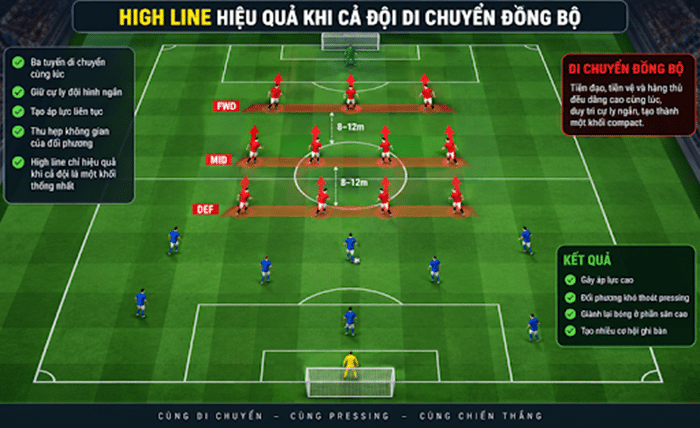
Modern football requires teams to control space, not just possession. When learning What Is a High Line, it can be understood as a defensive approach in which the back line pushes forward to reduce the playing area and support pressing.
1. What Is a High Line in Football?
Basically, What Is a High Line refers to a tactic in which the defenders position themselves higher up the pitch than in a traditional defensive setup. Instead of dropping close to their own penalty area, centre-backs and full-backs proactively push the defensive line towards the halfway line.
The aim is to reduce the distance between the defence, midfield and forwards. When the lines stay close together, the team can press more effectively and win the ball back quickly. On Xôi Lạc TV, viewers watching bong da truc tiep can identify a high line by observing the positions of the centre-backs.
2. What Principles Does a High Line Follow?
To understand What Is a High Line clearly, it is important to focus on coordination. The defence cannot push forward on its own if the players further up the pitch fail to put pressure on the player in possession. If the opposition has time to play long passes, the space behind the centre-backs becomes a weakness. A high line is therefore often combined with a high press to keep the team compact.
Xôi Lạc TV helps viewers observe how the entire system moves together as a unit.
3. The Biggest Advantages of a High Defensive Line
A high line helps a team control territory more effectively. When the defence pushes forward, the opposition is forced back into its own half and finds it harder to build attacks comfortably.
Understanding What Is a High Line also reveals the benefits of winning the ball close to the opposition’s goal. If the press succeeds, the attacking team may need only a few passes to create a chance.
A high defensive line also helps teams compete for second balls in midfield. Viewers on Xôi Lạc TV can combine this with lịch thi đấu bóng đá anh to choose matches featuring teams that press aggressively.
4. What Are the Risks of a High Line?
The most obvious weakness is the space behind the defensive line. If the opposition has a fast striker and a good passer, one accurate through ball can bypass the entire defence.
When analysing What Is a High Line, the centre-backs’ pace and the goalkeeper’s ability to read the game are particularly important. The goalkeeper often needs to position themselves high up the pitch and rush out to clear the ball, acting as a “sweeper keeper”.
On Xôi Lạc TV, when watching bong da truc tiep, viewers can pay attention to the goalkeeper’s positioning and how the centre-backs turn when an opponent plays a through ball.
5. How Is a High Line Related to the Offside Trap?
The offside trap is an important tool for a high defensive line. Defenders must step forward almost simultaneously to catch opposition forwards offside before the pass is played.
This shows that What Is a High Line is about more than simply standing high up the pitch. It requires communication, an understanding of when the pass will be played and coordination among the defenders. Even one player dropping back too late can cause the offside trap to fail. Xôi Lạc TV helps viewers observe these marginal situations.
6. How Can Teams Counter a High Line?
From an attacking perspective, a common way to exploit a high line is to use a fast striker who times their run correctly before receiving the ball behind the centre-backs.
A low through ball between a centre-back and a full-back can also break the defensive structure. Players who know how to start from an onside position and accelerate at the right moment are particularly dangerous.
When watching bong da truc tiep on Xôi Lạc TV, viewers should pay attenti\on to when the striker begins their run rather than focusing only on the final pass.
7. How Is a High Line Different from a High Press?
A high press involves putting pressure on the opposition high up the pitch, while a high line describes the positioning of the defence. The two concepts often work together, but they are not exactly the same.
If a team presses high without pushing its defensive line forward, a large gap can develop between the lines. Conversely, if the defence pushes high but the forwards fail to close down the opposition, opponents will have time to play passes into the space behind.
Those following lịch thi đấu bóng đá anh can choose Premier League matches to observe this difference. Xôi Lạc TV helps fans follow these situations in real matches.
8. What Qualities Are Needed to Play a High Line?
A team looking to operate a high line effectively needs quick centre-backs who read the game well and are comfortable defending large spaces. Full-backs must know when to push forward and when to drop back.
The goalkeeper needs good footwork and must be ready to leave the penalty area. Midfielders must also press quickly enough to prevent opponents from having time to play accurate passes.
Understanding What Is a High Line therefore means understanding a collective system. Xôi Lạc TV helps viewers observe this coordination through every phase of play.
9. When Is a High Line Most Effective?
A high line suits teams that want to control possession, play proactively and keep their opponents away from their own goal. This system is most effective when the forwards press well and the centre-backs have the pace to recover defensively.
When watching bong da truc tiep on Xôi Lạc TV, fans can easily recognise a high line by observing the centre-backs’ positioning, the offside trap and the goalkeeper’s role.